
25 Garden Bench Ideas With Built-In Planters

Garden benches are already hard to resist—but when they include built-in planters, they become little garden rooms all by themselves. Instead of separate seats and pots scattered around, you get one clear, easy-to-use piece that combines comfort with greenery in a really satisfying way.
This collection of 25 ideas focuses on benches with integrated planters: at the ends, behind your back, under your arms, and even right in front of your toes. You’ll find simple DIY-friendly concepts, modern deck-friendly designs, and cosy corner nooks. Whether you have a balcony, a small courtyard, or a big family garden, there’s a way to wrap plants right into your seating so you don’t just sit near the garden—you sit inside it.
Quick List
- L-Shaped Corner Bench With End Planters
- Straight Timber Bench With Side Box Planters
- U-Shaped Conversation Bench With Corner Planters
- Herb Bench With Backrest Planter Trough
- Pergola Bench With Post Planters
- Fire Pit Bench With Built-In Shrub Planters
- Floating Deck Bench With Hidden Planter Ends
- Pallet Bench With Crate Planter Arms
- Concrete Block Bench With Inset Planter Gaps
- Curved Bench With Central Tree Planter
- Storage Bench With Front Planter Pockets
- Minimalist Slatted Bench With Cube Planters
- Split-Level Bench With Step-Up Planters
- Kid-Friendly Story Bench With Butterfly Planters
- Balcony Bench With Rail-Hugging Planters
- Gravel Pad Bench With Back Wall Planter
- Bench Around Raised Bed Corner
- Garden View Bench With Low Hedge Planter
- Bench With Water Bowl And Bog Planter
- Shade Garden Bench With Fern Planters
- Porch Bench With House-Number Planter Box
- Bench With Trellis Back And Climber Planter
- Circular Bench With Petal Planters
- Bench Built Into Retaining Wall Planter
- Moveable Modular Bench And Planter Set
L-Shaped Corner Bench With End Planters

An L-shaped bench makes the most of a corner and feels naturally cozy. Build a low seat along two sides of a small paved or gravel pad, and extend the frame at each exposed end into chunky planters. Fill them with grasses, daisies, herbs, or even small shrubs to create soft “bookends.” Add cushions in a simple palette and a low table in the angle. The whole nook reads as one unified piece, not a jumble of furniture and pots.
- Best For: Garden corners and under-used patio edges.
- Budget Tip: Construct the bench and planters from the same basic decking boards or timber.
- Styling Idea: Repeat one plant type in both end planters to link the two arms visually.
- Practical Note: Line planters well and use a small air gap where the planter meets walls or fences.
Straight Timber Bench With Side Box Planters

A straight bench with planter boxes at each side is one of the simplest ways to get that “built-in” look. Think of it as a plank of seating with sturdy wooden cubes attached at both ends. You sit in the middle, with plants rising at your elbows—lavender, rosemary, or compact shrubs. It’s easy to place along a fence, wall, or path, and gives you a clear, tidy line.
- Best For: Long, narrow spaces along fences or house walls.
- Budget Tip: Use basic construction timber and protect it with outdoor stain rather than pricey hardwood.
- Styling Idea: Match the planter box height to the bench seat for a calm, continuous line.
- Practical Note: Ensure the bench support spans between planters so there’s no sag in the middle.
U-Shaped Conversation Bench With Corner Planters

A U-shaped bench around a small pad feels instantly sociable. Build three connected bench runs and use the two outer corners as deep planter blocks. These planters can hold taller plants that gently screen and shelter the seating—grasses, shrubs, or even small trees in large enough boxes. The rest of the U stays low and open. It’s a perfect layout for gathering around a central table, fire bowl, or just an attractive pot.
- Best For: Dedicated social corners or fire pit areas.
- Budget Tip: Build the U in stages—start with one bench and add the rest later.
- Styling Idea: Use contrasting seat cushions to break up all the timber.
- Practical Note: Leave enough gap between the central feature (table, fire) and the bench for easy access.
Herb Bench With Backrest Planter Trough

Here, the planter is behind your back. A simple bench with a tall backrest houses a trough planter right behind the top rail. Plant herbs and scented flowers so that when you lean back or the breeze moves, you catch fragrance—rosemary, lavender, thyme, mint. It turns a basic seat into a multi-sensory nook and is excellent near the kitchen.
- Best For: Patios just outside the kitchen door.
- Budget Tip: Keep the backrest structure simple; let the plants provide the drama.
- Styling Idea: Use terracotta-toned cushions to echo the idea of pots and herbs.
- Practical Note: Choose plants that won’t mind a bit of brushing or occasional back contact.
Pergola Bench With Post Planters
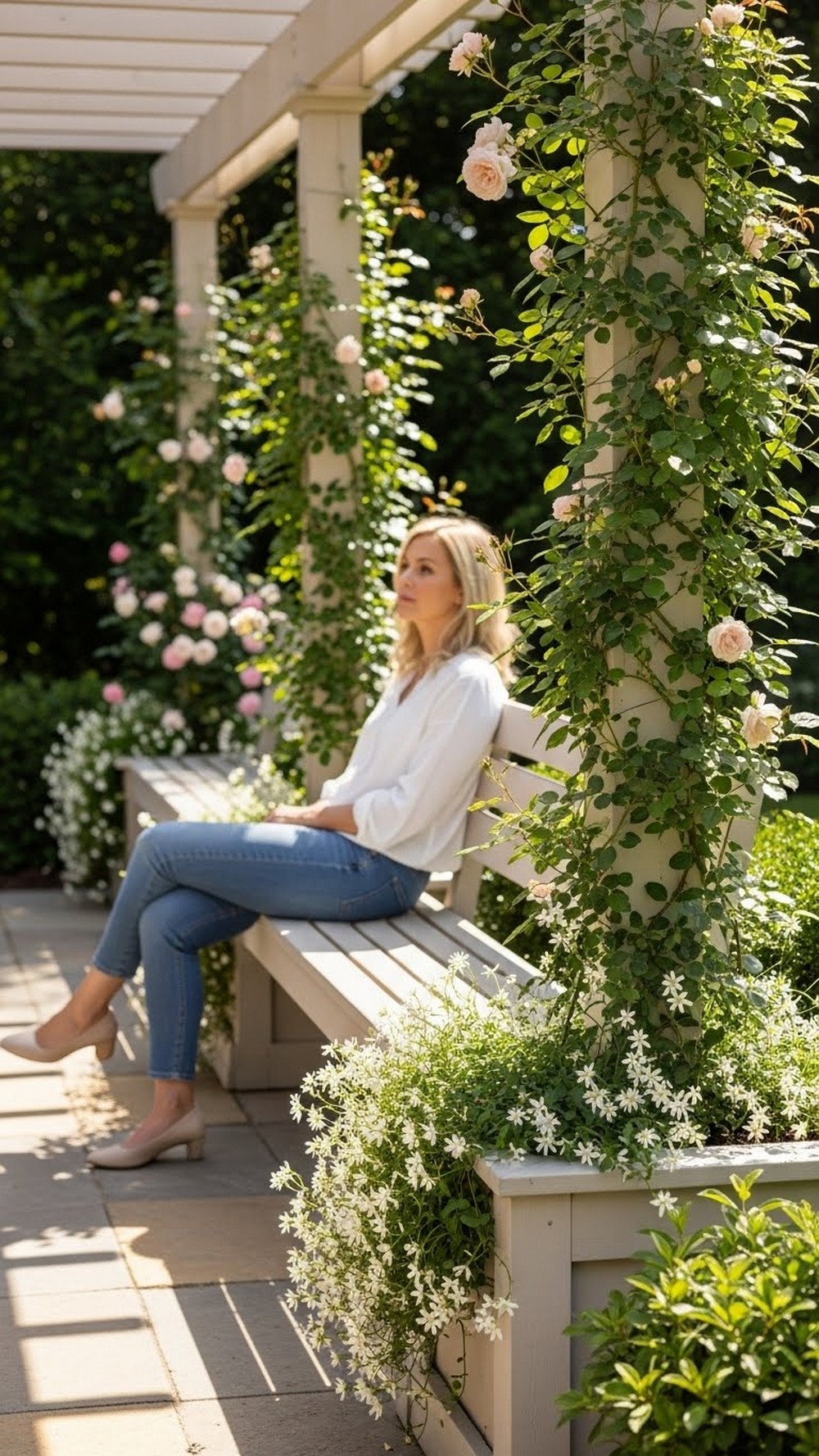
The posts of a pergola are natural spots for planters. Build a bench between posts and widen the base of each upright into a box planter. Climbing plants emerge at seat level and immediately start framing the bench as they grow up and over. In a year or two, you’ll be sitting inside a leafy frame, not just under a bare timber structure.
- Best For: Pergolas that feel a bit too “hard” or empty.
- Budget Tip: Use the same timber as your pergola so everything feels like one project.
- Styling Idea: Mix climbers with underplanting like trailing herbs or low flowers.
- Practical Note: Keep access for post-foot maintenance or future repairs in mind.
Fire Pit Bench With Built-In Shrub Planters

A partial ring of bench around a fire bowl feels much more natural than dragging chairs around every time. Integrate chunky planters between bench sections to break up the circle and add green structure. Shrubs or upright grasses in these boxes give the area a “room” feeling and look beautiful backlit by flames. It’s cozy, but because the seating is fixed, it also stays tidy.
- Best For: Gardens where evenings around a fire are a regular treat.
- Budget Tip: Keep bench backs low or skip them to reduce timber costs.
- Styling Idea: Choose warm-coloured cushions that echo the firelight.
- Practical Note: Position planters and plants at a safe distance from heat and sparks.
Floating Deck Bench With Hidden Planter Ends

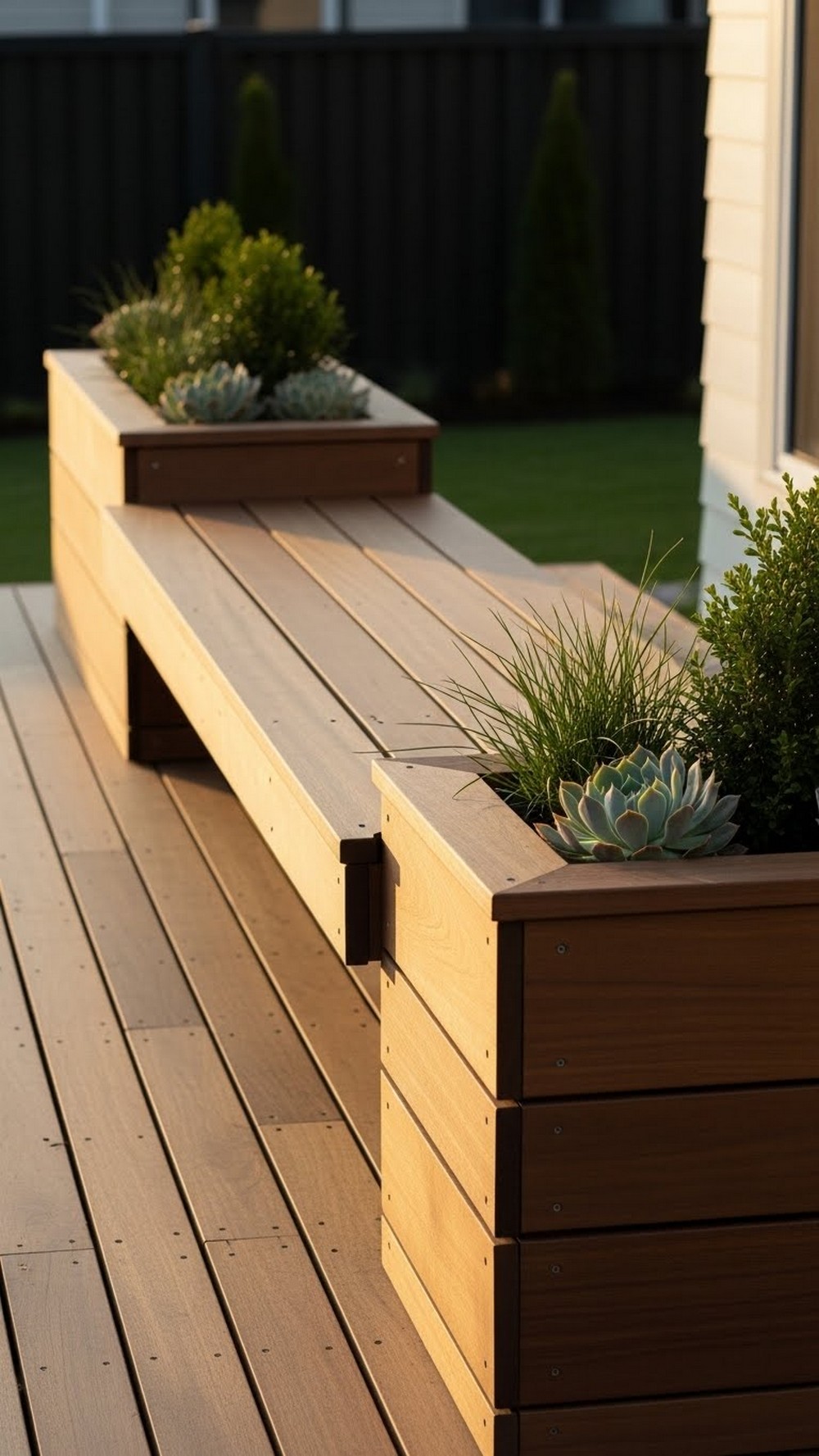
On a deck, a floating bench (without visible legs) looks sleek. Extend the bench frame into box planters at each end so they appear to grow right out of the deck edge. Plant with low-maintenance evergreens or succulents for a calm look. From a distance, it reads as one uninterrupted strip of wood and green, which makes small spaces feel more streamlined.
- Best For: Contemporary decks and roof terraces.
- Budget Tip: Use offcuts from decking boards for the planter cladding.
- Styling Idea: Keep plant choices simple and repeated for a minimalist feel.
- Practical Note: Allow for drainage from planters so water doesn’t sit on the deck.
Pallet Bench With Crate Planter Arms
If you like DIY, a pallet bench is very do-able. Screw pallet boards together for a simple seat and back, then attach wooden crates at the ends as chunky “arms” that are actually planters. The crates can hold bright annuals, herbs, or small shrubs, and you can swap them seasonally without changing the bench. It’s relaxed, budget-friendly, and perfect for cottage-style spaces.
- Best For: Informal gardens, rentals, or first projects.
- Budget Tip: Source pallets and crates free or cheaply and spend on good cushions.
- Styling Idea: Paint the bench and crates one colour, leaving some crate wood raw for contrast.
- Practical Note: Sand everything well and check for nails or splinters before use.
Concrete Block Bench With Inset Planter Gaps

Using stacked concrete blocks as supports and planters gives a robust, industrial feel. Lay timber boards across block stacks as seats, leaving some block cells open at the top for soil and plants. Tuck hardy, drought-tolerant species into those gaps—sedums, small grasses, thyme. The contrast between raw concrete and soft planting is really pleasing.
- Best For: Urban gardens and low-fuss corners.
- Budget Tip: Concrete blocks are often cheaper than ready-made supports.
- Styling Idea: Keep planting mainly green and textural for a sculptural look.
- Practical Note: Place the bench on a solid, level base so blocks don’t shift over time.
Curved Bench With Central Tree Planter

A bench that wraps around a tree gives you shade and a focal point in one. Build a circular or semi-circular planter around the trunk and cap the outer edge with a wide, smooth seat board. Under the tree, plant groundcovers, bulbs, or shade-loving flowers. The bench becomes the best place to appreciate that tree in all seasons.
- Best For: Yards with one standout tree in a good position.
- Budget Tip: Use simple vertical boards or sleepers for the planter sides.
- Styling Idea: Stain the bench a tone that echoes the tree’s bark.
- Practical Note: Allow extra space around the trunk to accommodate future growth.
Storage Bench With Front Planter Pockets

A hinged-seat storage bench is gold in a garden; adding planter pockets to the front makes it beautiful too. Build shallow troughs or boxes along the base and plant them with low or trailing plants. From the front, the bench looks like it’s nested in foliage. Inside, tools, cushions, and toys stay sheltered.
- Best For: Small gardens that need both storage and seating.
- Budget Tip: Use offcuts or pallet wood to build the planter fronts.
- Styling Idea: Plant with repeat colours to visually tie the pockets together.
- Practical Note: Ensure drainage from planter pockets doesn’t seep into the storage area.
Minimalist Slatted Bench With Cube Planters
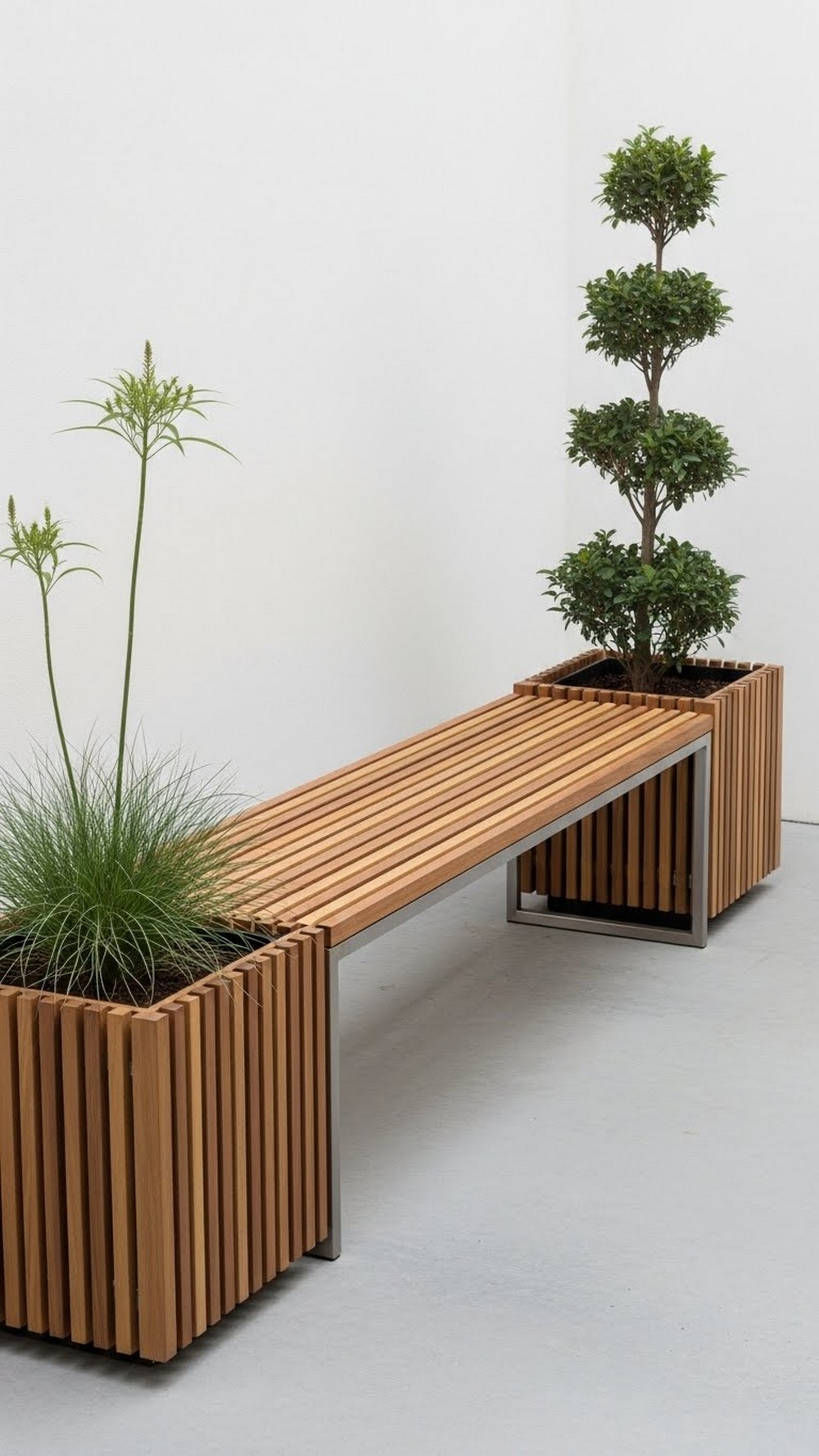
For a very clean look, pair a slim slatted bench with cube planters that act like full stops at each end. Keep everything the same material and colour: pale wood with pale pots, or darker timber with dark cubes. Plant each cube with a single statement plant—grasses, clipped shrubs, or even small trees. It feels more like a calm installation than typical garden furniture.
- Best For: Modern courtyards and small patios.
- Budget Tip: Build your own cubes from plywood or timber and seal them well.
- Styling Idea: Use monochrome cushions to keep the mood sleek.
- Practical Note: Check the bench is well supported between cubes, especially for longer spans.
Split-Level Bench With Step-Up Planters

Splitting a bench into two heights makes things interesting and practical—lower for lounging, higher for quick perch seating. Integrate a planter at the step-change point so plants bridge between levels. It could hold a taller grass or shrub that gently separates the two zones. From some angles, the bench and planter look like a single sculpted piece.
- Best For: Terraced gardens or spots with slight level changes.
- Budget Tip: Work with existing height changes rather than building new ones.
- Styling Idea: Echo the plant’s height change with cushion sizes or colours.
- Practical Note: Check the “step” between levels is visible and not a trip hazard.
Kid-Friendly Story Bench With Butterfly Planters
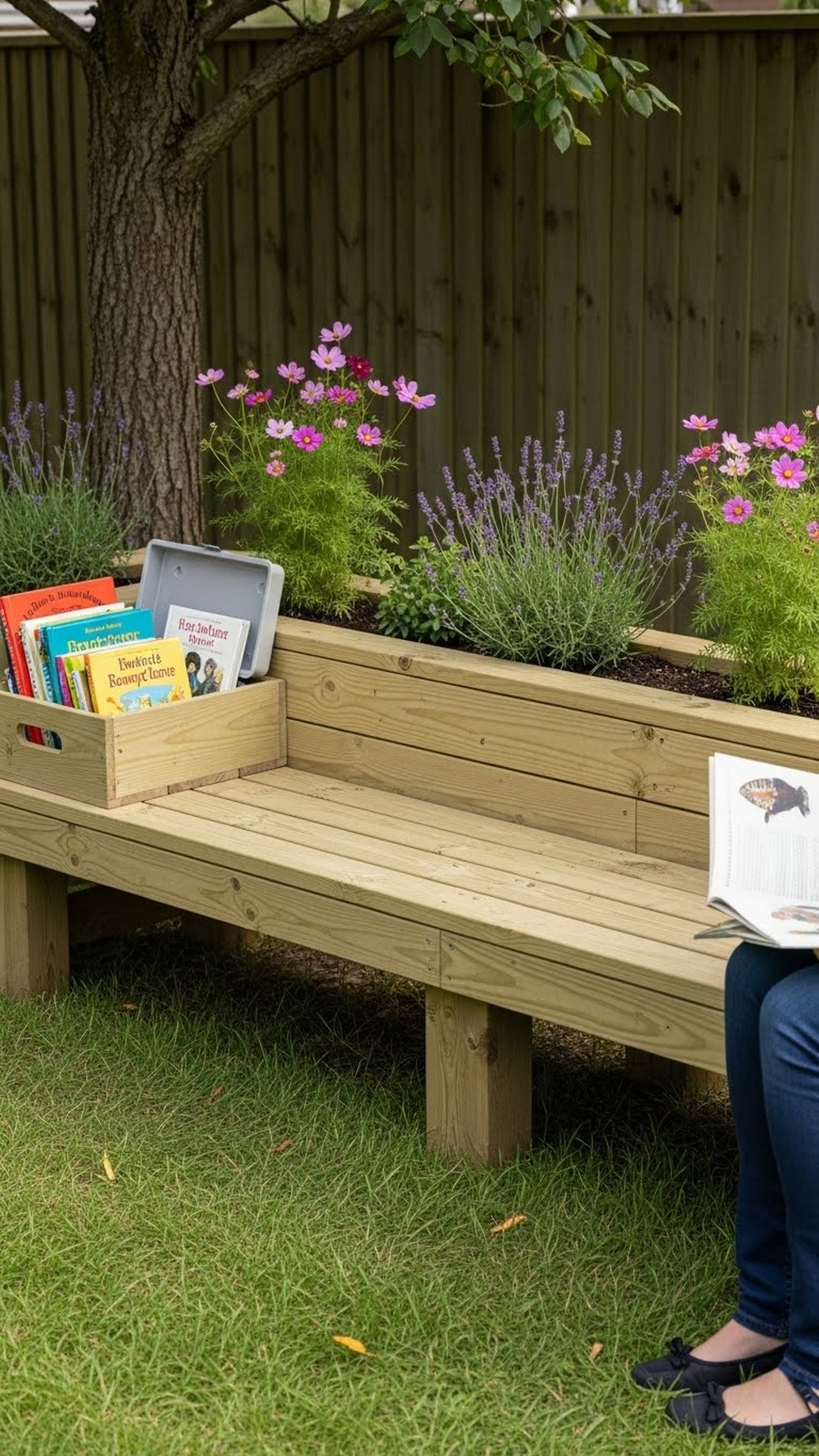
A low bench with built-in planters at the back or ends can become a storytime magnet. Fill planters with nectar plants that attract butterflies and bees, and keep a weatherproof box of books nearby. Adults can sit at one side, kids at the other, or all in a row watching pollinators. It makes the bench feel like a place for calm, shared moments instead of just another seat.
- Best For: Family gardens and school/childcare outdoor spaces.
- Budget Tip: Use robust, easy-to-grow flowering plants that cope with some attention.
- Styling Idea: Add a simple painted motif (butterflies, bees) on the planter fronts.
- Practical Note: Avoid plants with sharp thorns or irritating sap in this area.
Balcony Bench With Rail-Hugging Planters
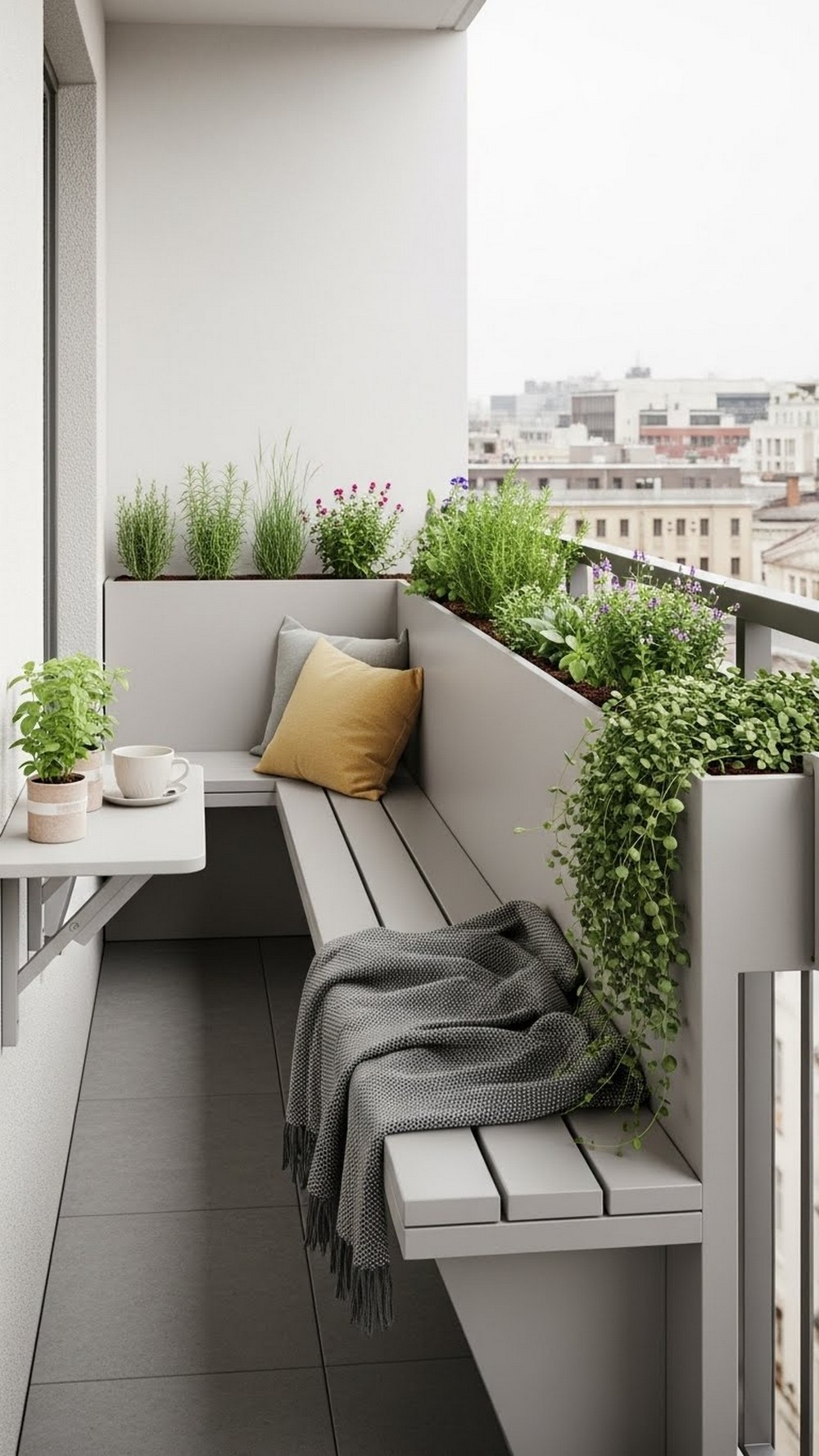
On a balcony, space is tight, so wrapping a planter into the back of a bench is ideal. The bench sits against the wall; the planter trough runs along the railing, joined to the bench frame. You get clear seating, plus a band of green and colour at eye level. It’s like a built-in window box with somewhere to sit and enjoy it.
- Best For: Apartments and roof terraces.
- Budget Tip: Build a simple frame that sits over existing rail planters.
- Styling Idea: Plant herbs and flowers together so it smells as good as it looks.
- Practical Note: Confirm balcony weight limits and secure planters against wind.
Gravel Pad Bench With Back Wall Planter
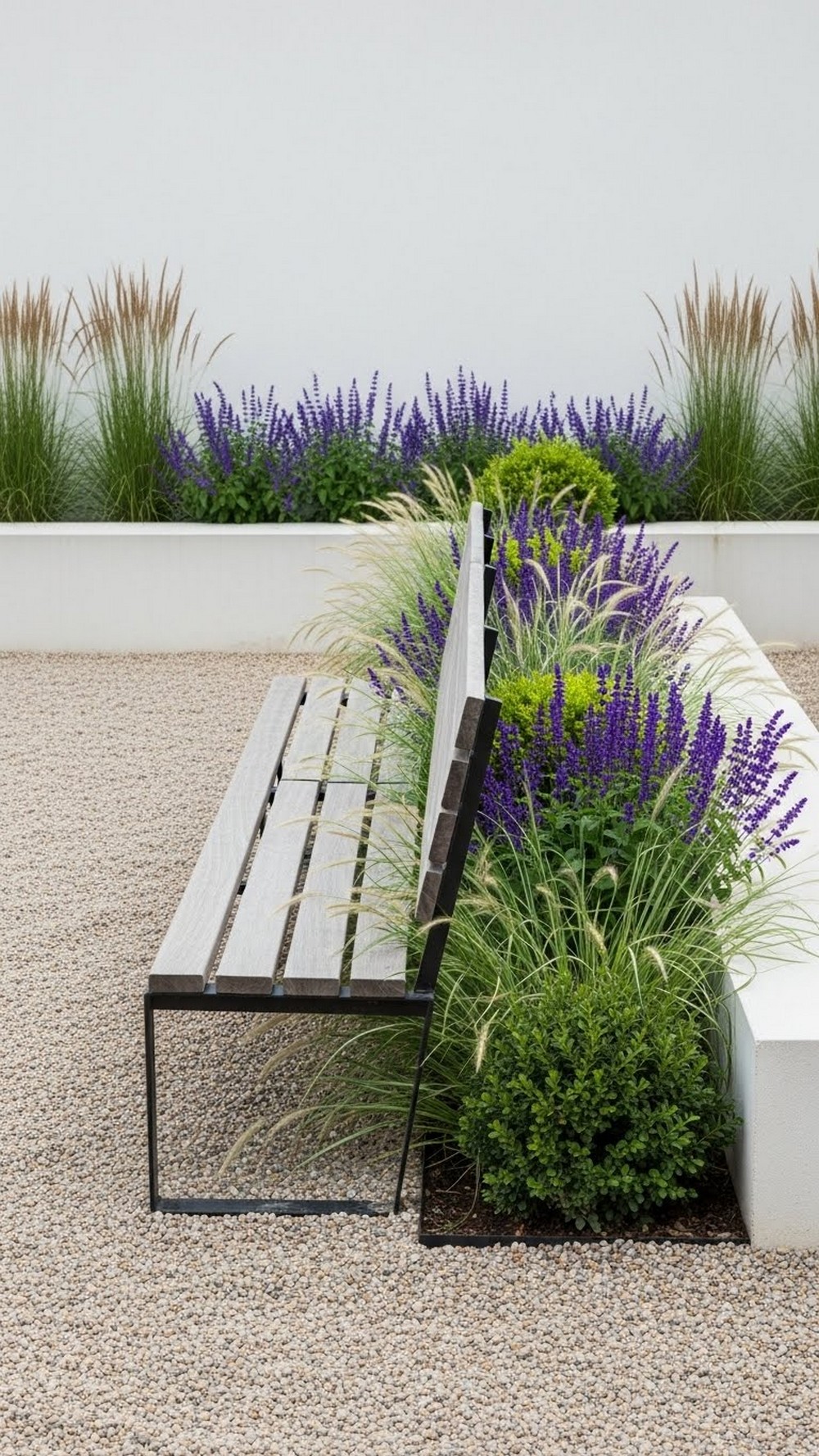
Here, the seat and plants share the same footprint as a tiny “room.” On a gravel pad, place a straight bench slightly away from a low back wall that functions as a planter. Fill it with grasses, salvia, small roses, or shrubs that rise behind the seat at shoulder height. When you sit, you’re backed by green and looking out at the rest of the garden.
- Best For: Small, defined seating zones.
- Budget Tip: Use concrete blocks or sleepers to build the simple planter wall.
- Styling Idea: Choose a single colour theme for the planting for a serene look.
- Practical Note: Ensure the wall is waterproofed properly if built against an existing structure.
Bench Around Raised Bed Corner

Let a raised bed help support a bench, and suddenly you’re sitting right where the action is. Extend the bed’s cap or coping outward into a comfortable seat at one corner, and support it with legs or short walls where needed. The planter soil and plants are behind your back, and the bed edge becomes armrest height. It’s great for kitchen gardens where you want to sit close while harvesting.
- Best For: Veg beds, herb gardens, and cutting gardens.
- Budget Tip: Upgrade just one corner of an existing bed rather than building new beds.
- Styling Idea: Use the same material for bench cap and bed edging for a seamless look.
- Practical Note: Let plants at that corner be slightly lower so they don’t poke the back of your head.
Garden View Bench With Low Hedge Planter

A simple bench facing a “view” becomes much more intentional if you place a low planter right in front of it. Fill the planter with a low hedge or repeated shrubs that sit below your sightline but above your feet. They frame the lower part of your view and make the bench feel anchored, almost like sitting behind a green balcony rail.
- Best For: Overlooking borders, ponds, or borrowed landscape.
- Budget Tip: Choose tough, slow-growing shrubs to reduce pruning.
- Styling Idea: Paint or stain the planter to match other garden structures.
- Practical Note: Keep the planter narrow so legroom isn’t cramped.
Bench With Water Bowl And Bog Planter
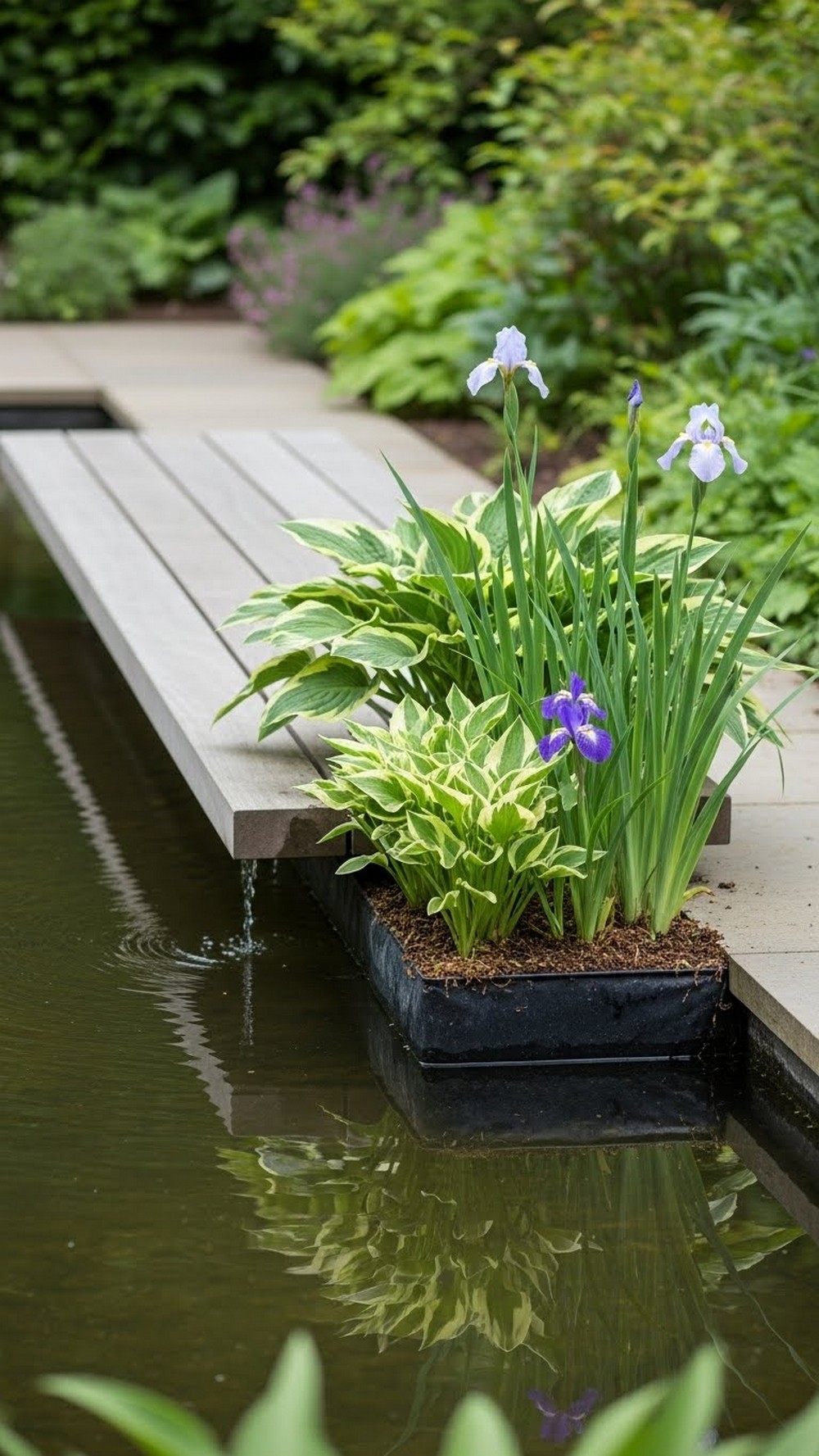
Pairing seating, water, and damp planting creates a mini sanctuary. One end of the bench becomes a built-in bog planter, lined to hold moisture and filled with damp-lovers—hostas, irises, ligularia. A shallow bowl or small pond sits just beyond. The plants help soften the hard edge of the water, and you get splashes of reflection while sitting somewhere practical.
- Best For: Spots where water naturally collects or near an existing pond.
- Budget Tip: Use a preformed liner or tub inside the planter to keep things contained.
- Styling Idea: Choose large-leafed plants for a lush, almost jungle feel.
- Practical Note: Make sure any water feature is safe around children and pets.
Shade Garden Bench With Fern Planters
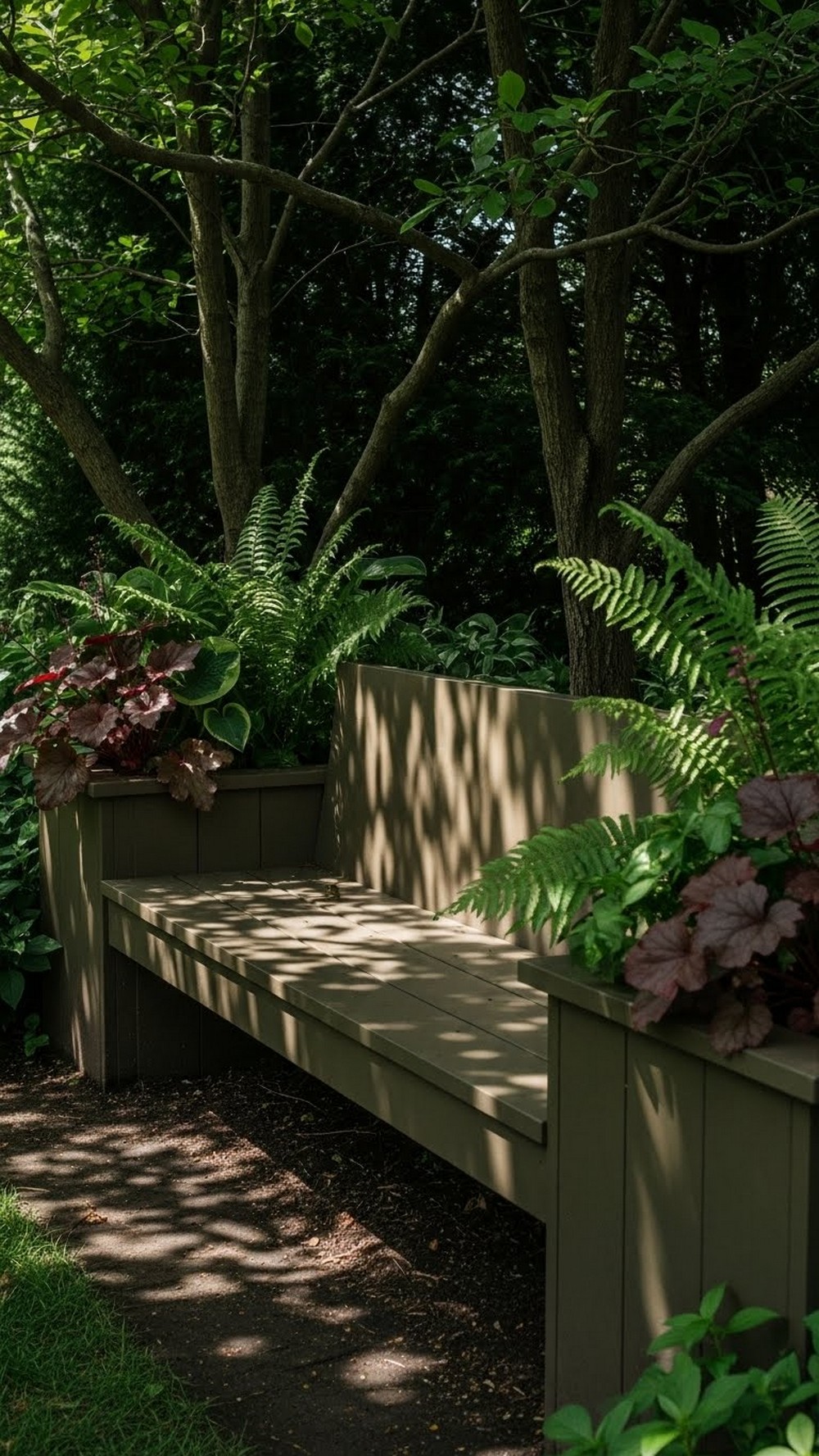
In deep shade, highlighting foliage is key. Build a bench between two generous planters and fill them with ferns, heucheras, hostas, and other shade lovers. Paint or stain the bench a deep, mossy tone so it settles into the setting. Sitting there feels like being tucked into a leafy niche, especially if you add a soft throw and cushions.
- Best For: North-facing corners or under trees.
- Budget Tip: Divide existing shade plants to fill the planters.
- Styling Idea: Mix different leaf shapes and sheens to catch what little light there is.
- Practical Note: Monitor moisture carefully—shade spots can be either dry or very wet.
Porch Bench With House-Number Planter Box

A porch or front-step bench can double as a welcome sign. Attach a planter box to one side and add your house number to the front, then plant with tidy evergreens and seasonal colour. It’s decorative, practical, and offers somewhere to sit while tying shoes or waiting for a taxi.
- Best For: Front entrances and stoops.
- Budget Tip: Use one evergreen “anchor” plant and change smaller flowers seasonally.
- Styling Idea: Match number colours to your door hardware or mailbox.
- Practical Note: Keep planting neat and low so the number stays visible.
Bench With Trellis Back And Climber Planter

Combine bench, planter, and trellis for a built-in green backdrop. Run a planter box along the back of the bench and fix a trellis rising from it. Plant climbers and filler plants at the base; as they grow, you’ll get shade, privacy, and scent. It’s effectively a living garden wall that you can sit right up against.
- Best For: Overlooked patios and boundaries that need soft screening.
- Budget Tip: Use a single robust climber plus a couple of inexpensive fillers.
- Styling Idea: Paint the trellis and planter the same colour to frame the planting.
- Practical Note: Choose climbers that won’t become so heavy they strain the trellis.
Circular Bench With Petal Planters

A partial circular bench is fun on its own; adding outward-facing “petal” planters makes it a real feature. Each wedge-shaped planter juts out from the bench and can host a different plant mix—herbs, flowers, grasses. The result is a seating ring surrounded by a halo of planting. Children in particular love climbing on and between the “petals.”
- Best For: Family gardens and central lawn features.
- Budget Tip: Limit yourself to a few repeated plant types across all petals.
- Styling Idea: Use a colour gradient—cool colours in some planters, warm in others.
- Practical Note: Keep path routes in mind so the circular layout doesn’t block movement.
Circular Bench With Petal Planters

A retaining wall is basically a raised planter already; extending its top into a bench is logical and lovely. Widen the coping stones or add a timber cap in one section for comfortable seating. Behind, the raised bed is planted with shrubs, perennials, or even edibles. You get a firm backrest, views of planting at eye level, and a neat use of a necessary structure.
- Best For: Sloping gardens with existing or planned walls.
- Budget Tip: Upgrade just one section of wall cap for seating instead of the whole length.
- Styling Idea: Choose plants that arch slightly over the seat but don’t poke people.
- Practical Note: Check the wall’s structural integrity before adding extra weight.
Moveable Modular Bench And Planter Set

Modular pieces give you built-in style with re-arrange-ability. Create several benches and planters that share the same footprint and height. You can then slot benches between planters to form a long line, an L-shape, or little clusters. Plants stay in place while seats shuffle, or vice versa. It’s like having outdoor “building blocks” you can reshape as your garden evolves.
- Best For: Flexible entertaining spaces and indecisive gardeners.
- Budget Tip: Start with one bench and two planters; expand the “set” over time.
- Styling Idea: Use a unified colour/stain on all modules so they read as a family.
- Practical Note: Keep individual units light enough that two people can move them safely.
Conclusion
Benches with built-in planters blur the line between “where you sit” and “where things grow,” and that’s where the magic is. They anchor seating, soften hard lines, and pack extra greenery into tight spaces—all while feeling calm and intentional instead of cluttered. You don’t need to build a huge, complicated structure; even a simple bench with a planter at one end can transform a corner. Start with one compact idea that suits how you actually use your garden and let the plants—and your seating nooks—grow from there.
FAQs
1. Do built-in planters need special lining or waterproofing?
Yes, they benefit from it. Line timber planters with landscape fabric or plastic (with drainage holes) to protect the wood and keep soil from washing out. If the bench is against a wall, make sure that side is properly waterproofed so moisture doesn’t seep into the structure.
2. What plants work best in bench planters?
Compact, long-lasting plants are ideal. For sun, think lavender, rosemary, small grasses, hardy geraniums, dwarf roses, and herbs. For shade, try ferns, heucheras, hostas, and small evergreen shrubs. Avoid very tall, brittle, or spiky plants right next to where people lean and move.
3. How deep should built-in planters be?
For most perennials and small shrubs, aim for at least 25–30 cm of soil depth; more if you want to grow bigger plants. Shallow pockets (15–20 cm) are fine for herbs, annual flowers, and succulents. Deeper planters dry out more slowly, which is helpful around seating areas.
4. Will benches with planters be harder to maintain than separate pots?
Not necessarily. The main difference is making sure drainage is well thought out and you can still access the back or underside for repairs. Once built, you’re largely just watering, pruning, and occasionally refreshing plants, same as with pots—only everything looks more pulled together.
5. Can I add planters to an existing bench instead of building from scratch?
Absolutely. You can attach planter boxes to the ends, behind the back, or in front as low troughs. Just make sure any added weight is supported and doesn’t twist the bench frame. Matching materials or paint/stain will help your add-ons feel like they were always meant to be there.


